The tallow balm has quietly become one of the most talked-about products in natural skincare, and for good reason. A well-made tallow balm works with your skin rather than against it, because the fat itself is so close to the lipids your skin already produces. The problem is that the label now covers everything from genuinely considered formulas to jars that are little more than rendered fat blended with the cheapest oils a manufacturer could find. They are not all the same, and the difference lives in what goes in alongside the tallow.
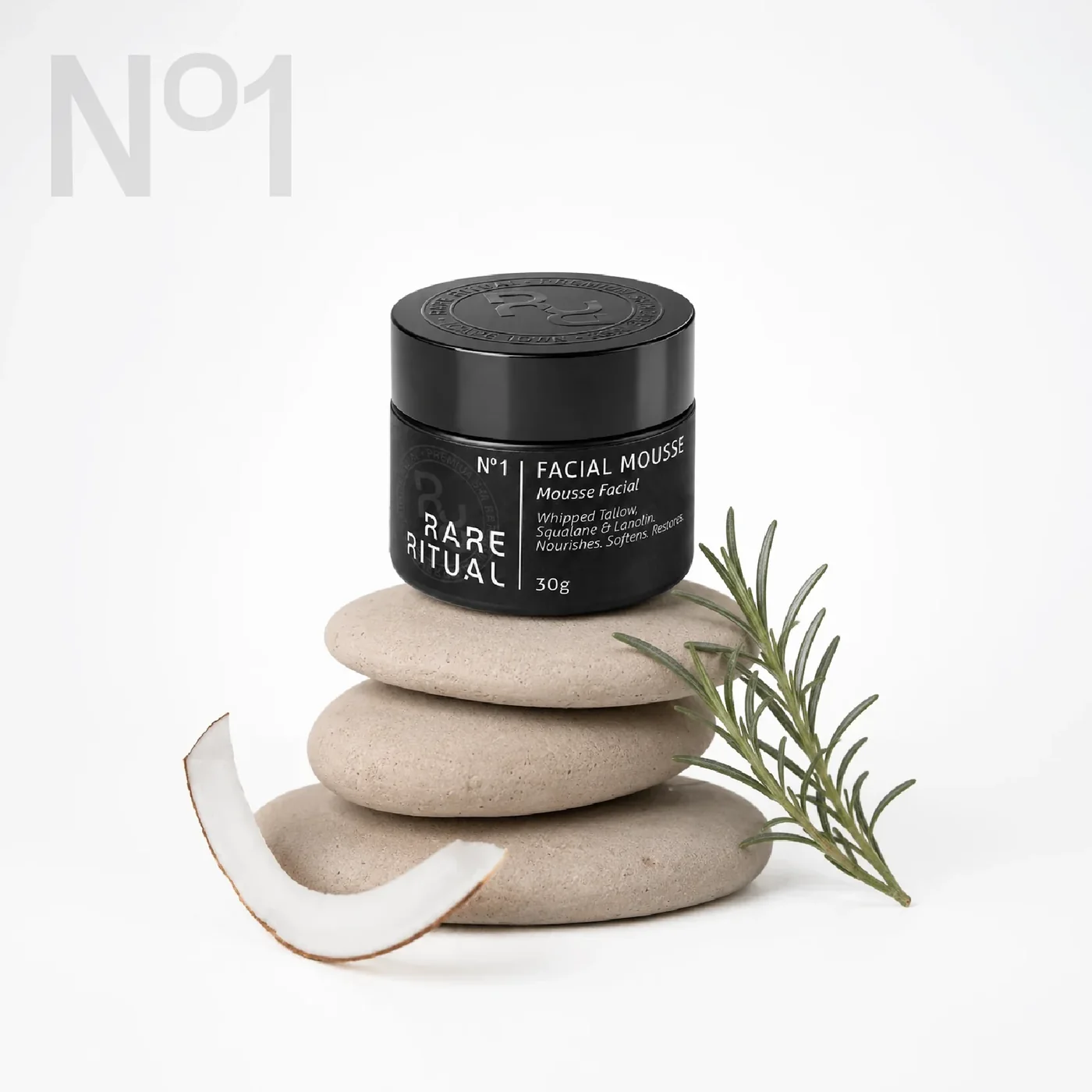
When we built the No 01 Facial Mousse, our tallow balm for the face, we treated every other ingredient as seriously as the tallow itself. We could have bulked it out with inexpensive filler oils and left it at that. Instead we chose each oil, wax, starch and extract for what it does for your skin, and for how the finished balm feels going on. Here is what that decision actually looks like.
Most tallow balms stop at the cheapest oils
Read the ingredient list on many tallow balms and you will often find castor oil and olive oil making up much of the jar. There is nothing wrong with either oil in principle, but they are frequently chosen for one reason above all others: they are inexpensive and easy to source in volume. Castor oil is extremely thick and has a tacky, draggy feel that tends to sit heavily on the skin. Olive oil is high in oleic acid, which makes it rich but also slow to absorb and more prone to oxidising over time. Lean on them too heavily and you get a balm that feels greasy, takes an age to sink in, and does little beyond the most basic moisture.
A tallow balm can do so much more than that. Tallow is already an exceptional base, so the ingredients you pair with it should raise the formula, not dilute it to protect a margin. That is the gap we set out to close.
How we elevated our tallow balm
Our starting point is grass-fed tallow, used as the heart of the formula rather than a filler. Its fatty acid profile, rich in oleic, palmitic and stearic acids, closely mirrors the lipids in human skin, which is why tallow tends to absorb and condition rather than simply sit on the surface. From there, instead of reaching for cheap bulk oils, we layered in a considered blend chosen to complement the tallow and to support a healthy-looking, resilient barrier.
The oils we chose instead
Jojoba is technically a liquid wax ester, and its structure is remarkably close to the skin’s own sebum. It absorbs cleanly, helps keep the skin balanced, and is well tolerated even by people who break out easily, which is exactly what you want layered into a rich base.
Squalane is a lightweight, skin-identical emollient that reinforces the skin’s lipid layer and helps slow water loss, all without a heavy or greasy feel. It is also exceptionally stable, so it will not turn or oxidise quickly the way some cheaper oils do.
Fractionated coconut oil, listed as caprylic and capric triglyceride, is a light, dry-touch carrier refined from coconut. It gives the balm its effortless slip and helps the richer ingredients spread evenly and absorb, instead of pooling on the surface.
Lanolin is one of the closest natural matches to the skin’s own surface lipids. It is a breathable occlusive that helps the skin hold on to water, which makes it invaluable for very dry, tight or weather-exposed skin, and far more skin-friendly than the petrolatum many balms reach for to do the same job.
The structure and the finish
Beeswax, listed as cera alba, forms a light protective veil that helps seal moisture in while still letting the skin breathe, and it gives the balm its structure. Stearic acid is a fatty acid found naturally in both skin and tallow, and it lends a cushioned, creamy body. Cetyl alcohol is a gentle fatty alcohol, not a drying one, that smooths the texture and gives the formula its soft glide.
The detail most balms miss is the finish. We blend in two natural plant starches, tapioca and arrowroot, which give the formula its signature powder-soft, velvety feel. They take the edge off the natural richness of tallow so the balm wears like a mousse rather than a grease, and leave skin feeling soft to the touch instead of shiny. This is the single biggest reason our tallow balm feels nothing like a heavy castor-and-olive blend.
The protective layer
Finally, a dual antioxidant system of vitamin E and rosemary leaf extract helps protect both the formula and the skin against oxidative stress, and keeps the natural oils fresh without any synthetic preservatives. A whisper of natural essential oils gives a soft, clean scent, with no synthetic fragrance. Because the balm is fully anhydrous, meaning it contains no water, every ingredient in the jar is a working one.
A tallow balm built for real skin
All of this adds up to a tallow balm that suits the skin types that gain the most from replacing lost lipids: dry, mature, sensitive, and skin with a compromised or stressed barrier. The No 01 Facial Mousse is designed as the final, sealing step in a routine, pressed into slightly damp skin to lock in everything applied beneath it.
If you want the same barrier-supporting philosophy for the body, the No 02 Body Melt brings a whipped tallow base to larger areas and melts in without greasy residue. You can see how the whole range is built, and exactly what goes into each formula, in the tallow skincare collection, and we go deeper into the lipid science behind it in our guide to tallow for skin.
The point of an elevated tallow balm is simple. Every ingredient in the jar should earn its place and do something for your skin, which is why we publish the full list and the reasoning behind it. Tallow gives us a base the skin already understands. The oils, waxes, starches and antioxidants we choose to put alongside it are what turn a basic balm into one you will actually look forward to using. That is the difference between a tallow balm built to a price and one built for your skin.