The case for tallow for skin starts with a simple observation. There is a quiet revolution happening in high-performance skincare, and it starts with an ingredient most people associate with old-fashioned cooking rather than a cabinet full of serums and creams. Tallow, the rendered fat of grass-fed cattle, was the original skin moisturiser. For most of human history, it was what people used. Then the petrochemical age arrived, and petroleum-derived substitutes became cheaper, easier to manufacture at scale, and infinitely more marketable. Tallow got quietly shelved.
Why tallow for skin works: the fatty acid profile of grass-fed tallow is remarkably close to human sebum, which is exactly why tallow for skin absorbs readily, supports the barrier, and behaves nothing like petroleum-derived occlusives. Used well, tallow for skin is the closest thing to a true biocompatible base in modern skincare.
What did not change was the biology.
The reason tallow for skin works as well as the research suggests has nothing to do with trend-chasing or ancestral nostalgia. It comes down to fatty acids. Specifically, the fatty acid profile of grass-fed tallow, rich in oleic, palmitic, stearic, and linoleic acid, is remarkably similar to the fatty acid profile of human sebum. The skin recognises it. Absorbs it readily. Integrates it into the barrier structure the way it does its own natural oils. That is not marketing language. That is lipid chemistry.
The return of tallow to luxury skincare is not a social media moment. It is a correction.
Why the Fatty Acid Profile Makes Tallow for Skin So Effective
The human skin barrier is built from lipids: ceramides, cholesterol, and fatty acids. Oleic acid, palmitic acid, and stearic acid are among the key fatty acids that hold the barrier together, regulate water loss, and keep skin comfortable and resilient. These are exactly the fatty acids found in high concentration in grass-fed tallow.
When the skin barrier is compromised, through environmental stress, over-cleansing, age, or harsh actives, the most effective way to restore it is to replenish what it has lost. Replenishing with lipids that the skin already knows how to process makes barrier recovery more efficient and more complete.
What is unusual about tallow is not just the fatty acid content, but the ratio. Oleic acid supports barrier flexibility and helps other lipids penetrate. Palmitic acid mimics the skin’s own ceramide-adjacent lipids. Stearic acid provides structural stability. Together, in roughly the proportions that human sebum produces them, they give tallow its uniquely skin-compatible character.
Grass-fed matters here too. The fatty acid composition of tallow varies with the animal’s diet. Grass-fed cattle produce tallow with a higher conjugated linoleic acid content and a more complex fatty acid profile overall, making it closer to the skin’s own composition than grain-fed equivalents.
Lanolin and the Science of Deep Barrier Integration
Tallow is rarely used alone in high-performance formulation. Lanolin is its natural counterpart: a waxy substance pressed from the secretions of sheep’s wool that has been studied intensively in cosmetic science for decades.
What makes lanolin remarkable is its molecular complexity. It does not sit on the skin surface the way simpler emollients do. Its structure allows it to integrate into the intercellular spaces of the stratum corneum, the outermost layer of the skin, in a way that no synthetic substitute has quite managed to replicate. It holds moisture, seals the barrier, and supports skin that is seriously dry or compromised.
Lanolin is one of the most deeply conditioning emollients available in natural formulation. Together with tallow, it creates a barrier system that is both immediate and sustained. A small portion of the population experiences sensitivity to lanolin. Patch testing before first use is always advisable.
Squalane and Jojoba: The Lightweight Counterbalance
Squalane, the stabilised form of squalene, is a lipid your skin produces naturally as part of its own protective oil film. Topical squalane is completely non-comedogenic and absorbs without any trace of heaviness, adding lightweight lipid replenishment to the deeper, more occlusive work of tallow and lanolin.
Jojoba oil is technically not an oil at all. It is a liquid wax ester, with a molecular structure that closely resembles the skin’s own sebum. Because it is a wax rather than a triglyceride, it cannot oxidise or go rancid, making it one of the most shelf-stable natural ingredients available. It contributes silky spreadability and a skin feel that is genuinely unlike most conventional plant oils.
Together, tallow, squalane, and jojoba create a layered lipid system that supports the skin barrier at multiple levels simultaneously. Tallow and lanolin do the deep work. Squalane provides lightweight topical replenishment. Jojoba carries the formula and conditions the surface.
The Role of Tapioca Starch and Arrowroot Powder
Richness and wearability are often in tension in skincare. The nourishing ingredients that genuinely support a compromised skin barrier tend to be the same ones that can feel heavy on the skin surface after application.
Tapioca starch (Manihot Esculenta Starch) and arrowroot powder (Maranta Arundinacea Root Powder) solve this elegantly. These ultra-fine plant powders sit on the skin surface after application, absorbing excess oil and diffusing light for a powder-soft, matte finish. They are what makes it possible to formulate with grass-fed tallow, lanolin, and squalane and still arrive at something comfortable and genuinely wearable throughout the day.
Antioxidant Protection in a Lipid-Rich Formula
Any lipid-rich formula carries a responsibility around oxidative stability. Tallow and plant oils contain fatty acids that can oxidise when exposed to light, heat, and oxygen over time. The solution is a robust, dual-pathway antioxidant system.
Vitamin E, specifically mixed tocopherols rather than a single synthetic form, works through one antioxidant pathway. Rosemary oleoresin extract (Rosmarinus Officinalis Leaf Extract) works through a different one. Together they provide more complete oxidative protection than either could achieve alone, protecting both the formula and the skin from the oxidative stress that contributes to visible signs of aging.
What Tallow for Skin Means for Your Routine in Practice
The research case for tallow for skin is straightforward. It delivers a skin-identical fatty acid profile that the skin recognises and integrates readily. It restores barrier function by replenishing the specific lipids the barrier is built from. It supports genuine, lasting nourishment rather than the surface moisture that evaporates with a water-based cream.
For skin that is dry, compromised, stripped by over-cleansing, or simply asking for something more nourishing than a lightweight moisturiser, tallow-based formulation offers something that most conventional skincare does not.
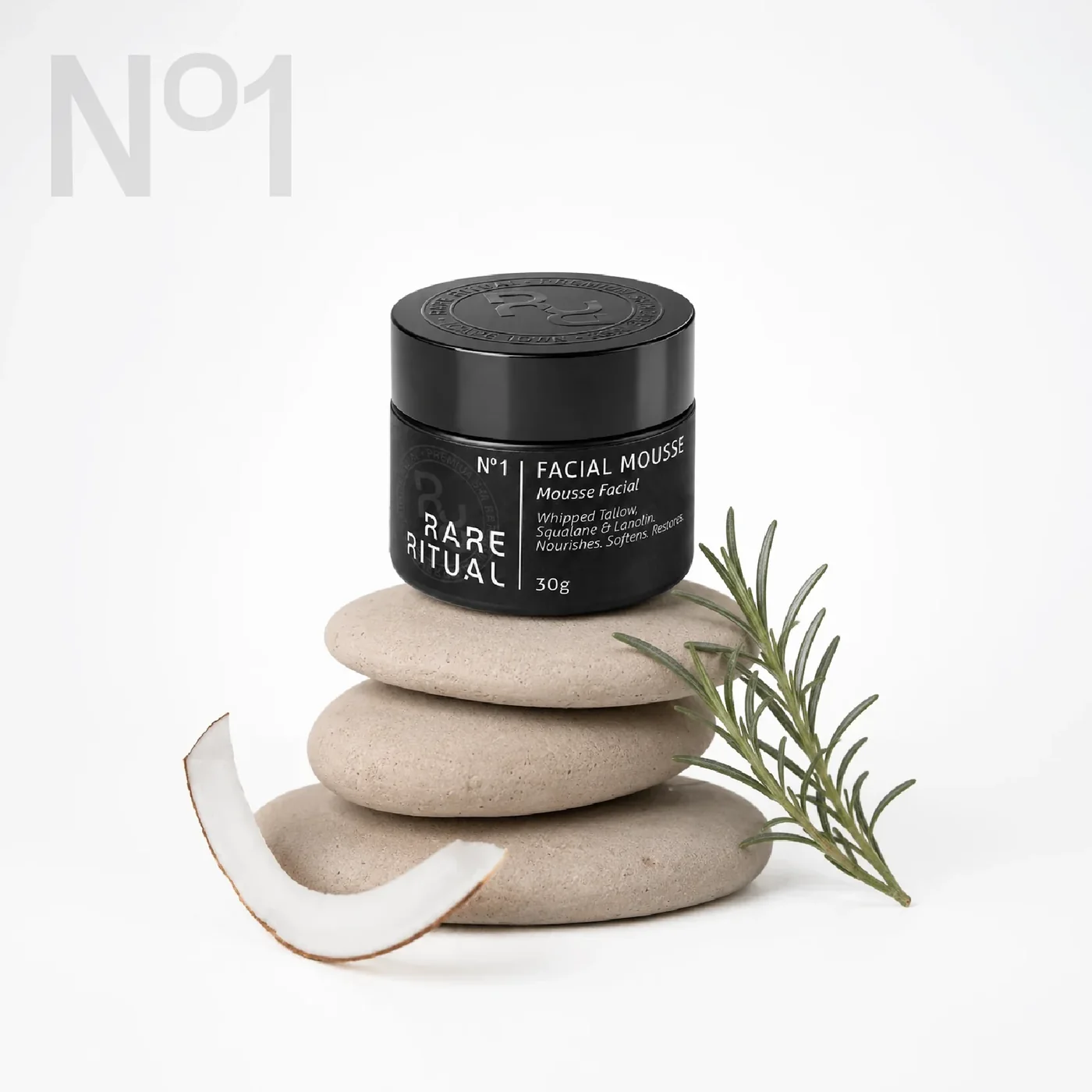
All of these ingredients, grass-fed tallow, lanolin, squalane, jojoba, tapioca starch, arrowroot powder, mixed tocopherols, and rosemary extract, come together in No 01 Tallow Facial Mousse by Rare Ritual. Whipped into a lightweight mousse with a powder-soft dry-down finish, it is formulated for daily use across all skin types. If tallow for skin is something you are curious about, this is the place to start.
Grass-fed tallow, lanolin, squalane, jojoba, tapioca starch, arrowroot powder, and mixed tocopherols all come together in No 01 Facial Mousse by Rare Ritual. A tallow-based facial moisturiser that brings the full science of tallow for skin into a single daily formula.