Tallow skincare is growing quickly in South Africa, and the reason comes down to basic skin chemistry. Tallow, the rendered fat of grass-fed cattle, is an emollient and occlusive: it softens the skin surface and slows the loss of water through the skin barrier. Those two functions, working together, are what make a dry or compromised skin feel restored after application. What makes tallow unusual compared to most plant-based emollients is the particular fatty acids it delivers, and how closely they overlap with the lipids the skin itself produces.
This article covers what tallow actually does on the skin, what the science says about its fatty acid profile, and why it has earned a serious place in a minimalist skincare routine.
What Is Tallow Skincare?
Tallow skincare refers to formulated products, face balms, body treatments, and lip products, that use rendered grass-fed animal fat as a primary ingredient. The ingredient is classified in cosmetic science as an emollient and an occlusive, two of the three ways a skincare product can support skin hydration.
To understand why that classification matters, it helps to know how skin hydration actually works. The skin holds water not by pulling it in from the outside but by keeping it from escaping. The outermost layer of the skin, the stratum corneum, is built from dead skin cells embedded in a lipid matrix, a mix of ceramides, fatty acids, and cholesterol that acts as a seal. When that lipid matrix is intact, water stays in. When it is damaged or depleted, moisture escapes continuously in a process called transepidermal water loss, or TEWL, and skin feels dry, tight, and reactive.
Emollients soften and smooth the skin surface by filling the microscopic gaps between surface skin cells. Occlusives slow TEWL by forming a lipid layer on the skin surface that reduces evaporation. Tallow does both. The third mechanism, humectancy, draws water into the skin from the environment or deeper tissue. Tallow does not act as a humectant. This is not a limitation. For most dry skin conditions, barrier support is the higher priority.
The Fatty Acid Science Behind Tallow Skincare
The fatty acid composition of grass-fed tallow contains oleic, palmitic, and stearic acids alongside smaller amounts of linoleic and linolenic acids. These proportions vary by season, breed, and diet, which is why sourcing from consistently grass-fed animals matters for quality.
Oleic acid is the dominant fatty acid and is responsible for much of tallow’s penetrating, emollient quality. In published research on skin penetration, oleic acid is studied as a natural penetration enhancer: it integrates into the lipid structure between skin cells and improves the delivery of other lipid-soluble actives. It is also a major fatty acid in human sebum, which explains why oleic-rich emollients tend to absorb readily rather than sitting on the surface. That said, concentrated oleic acid applied to already-compromised barrier skin has shown potential for barrier disruption in some studies, which is why the formulation context matters. In a well-blended tallow formulation alongside palmitic, stearic, and other lipids, the behaviour is different from isolated oleic acid.
Palmitic acid is one of the skin’s own barrier lipids. It is a precursor in the ceramide synthesis pathway, the chain of processes the skin uses to produce its own barrier fats. It also contributes to the skin-surface film that reduces TEWL. Its presence in tallow means the skin is receiving a fatty acid it already uses structurally.
Stearic acid contributes to barrier integrity and has a published mild anti-inflammatory profile in topical studies. It is also a natural component of the stratum corneum lipid matrix. Like palmitic acid, it is a fatty acid the skin already knows how to work with.
Linoleic acid is present at lower concentrations in tallow but carries significance: it is an essential fatty acid the body cannot synthesise on its own. Linoleic acid deficiency is associated with a compromised skin barrier and increased TEWL. Even at low concentrations, its presence in a topical formulation provides the skin with a fatty acid it cannot make internally.
Tallow Skincare vs. Conventional Emollients: What Makes It Different
Most conventional skincare products described as moisturisers are oil-in-water or water-in-oil emulsions. They combine a water phase with emulsifiers, humectants, emollients, and occlusives to create a spreadable texture. The water phase delivers an immediate sensation of freshness but evaporates; the residual film of emollients and occlusives is what provides lasting barrier support.
Tallow skincare is anhydrous: no water phase, no emulsifiers to hold one together. What you apply is purely lipid-based, which means the occlusive and emollient components are at full concentration rather than diluted into an emulsion base. For skin that is genuinely barrier-compromised or chronically dry, this matters. There is no water phase to evaporate, and no preservative system required to prevent microbial growth in that water phase.
Against purely synthetic occlusives like petrolatum and mineral oil, tallow presents a different profile. Petrolatum is highly effective at occlusion but is inert: it sits on the skin surface and reduces TEWL without contributing any biologically active fatty acids. Tallow delivers fatty acids that participate in the skin’s own lipid chemistry. Whether that translates into measurably better outcomes than petrolatum for most people is a question that direct clinical comparison has not yet fully answered, but the mechanism is meaningfully different.
Against plant-based emollient oils, tallow offers relatively high oxidative stability. Oils high in polyunsaturated fatty acids, like rosehip or evening primrose, oxidise more quickly both in the jar and on the skin surface. Oxidised lipids can generate free radicals that contribute to low-grade irritation. Tallow, being predominantly saturated and monounsaturated, is inherently more stable, which is one reason it has been used as a topical emollient in warm, dry climates for a very long time.
What the Research on Tallow Skincare Actually Shows
It is worth being direct about the evidence base. The individual fatty acids in tallow, oleic, palmitic, stearic, and linoleic acid, are well-studied in the context of skin biology and barrier function. That research is robust and extensive. What is less studied is tallow as a whole formulation applied to human skin.
A 2024 scoping review published in PubMed Central (PMC11193910) assessed the biocompatibility of rendered animal fat with human skin and concluded that tallow contains fatty acids with documented biological relevance to skin barrier function. The review also noted that direct clinical trials evaluating tallow formulations are limited, and that further research is needed before strong clinical recommendations can be made.
This is a common position for traditional ingredients experiencing renewed interest: the component science is strong, the formulation evidence is still catching up. For a brand using tallow, this means the claims must be grounded in the ingredient-level research and described correctly. Tallow supports barrier function, delivers bioavailable fatty acids, and functions as an effective emollient and occlusive. Those are defensible claims. Claims that tallow heals, repairs, or reverses skin conditions are not.
Grass-Fed Tallow: Why the Source Matters for Tallow Skincare
Tallow from grain-fed cattle has a different fatty acid profile from tallow rendered from grass-fed and pasture-raised animals. Grass-fed tallow is richer in conjugated linoleic acid (CLA), higher in fat-soluble vitamins including A, D, E, and K, and generally has a better ratio of omega-3 to omega-6 fatty acids. These differences are meaningful because the quality of the lipid you apply topically depends directly on the quality of what went into the animal.
South Africa has strong infrastructure for grass-fed and pasture-raised beef production. Local grass-fed tallow provides the same quality inputs as imported alternatives without the supply chain opacity that affects products sourced overseas. For a brand committed to ingredient transparency, locally sourced grass-fed tallow is a natural fit.
What to Expect When You Start Using Tallow Skincare
First-time users of tallow-based products most often ask about texture and smell. In a well-formulated product, tallow is blended with carrier oils and botanical extracts to create a smooth, spreadable texture. Properly rendered and deodorised tallow has a very mild, nearly neutral scent that is undetectable once blended with essential oils or plant extracts. The finished product does not smell like meat.
For dry, sensitive, or barrier-compromised skin, tallow-based emollients tend to feel immediately comfortable because the fatty acid profile is structurally compatible with the skin’s own lipids. For oily or congestion-prone skin, the anhydrous concentration means a little goes a long way. Starting with a small amount on particularly dry areas is sensible.
Some people transitioning from synthetic moisturisers notice an adjustment period as their skin recalibrates. This is less about tallow specifically and more about the shift from water-based to anhydrous formulations, which behave differently on the skin surface.
Where Tallow Skincare Comes Together
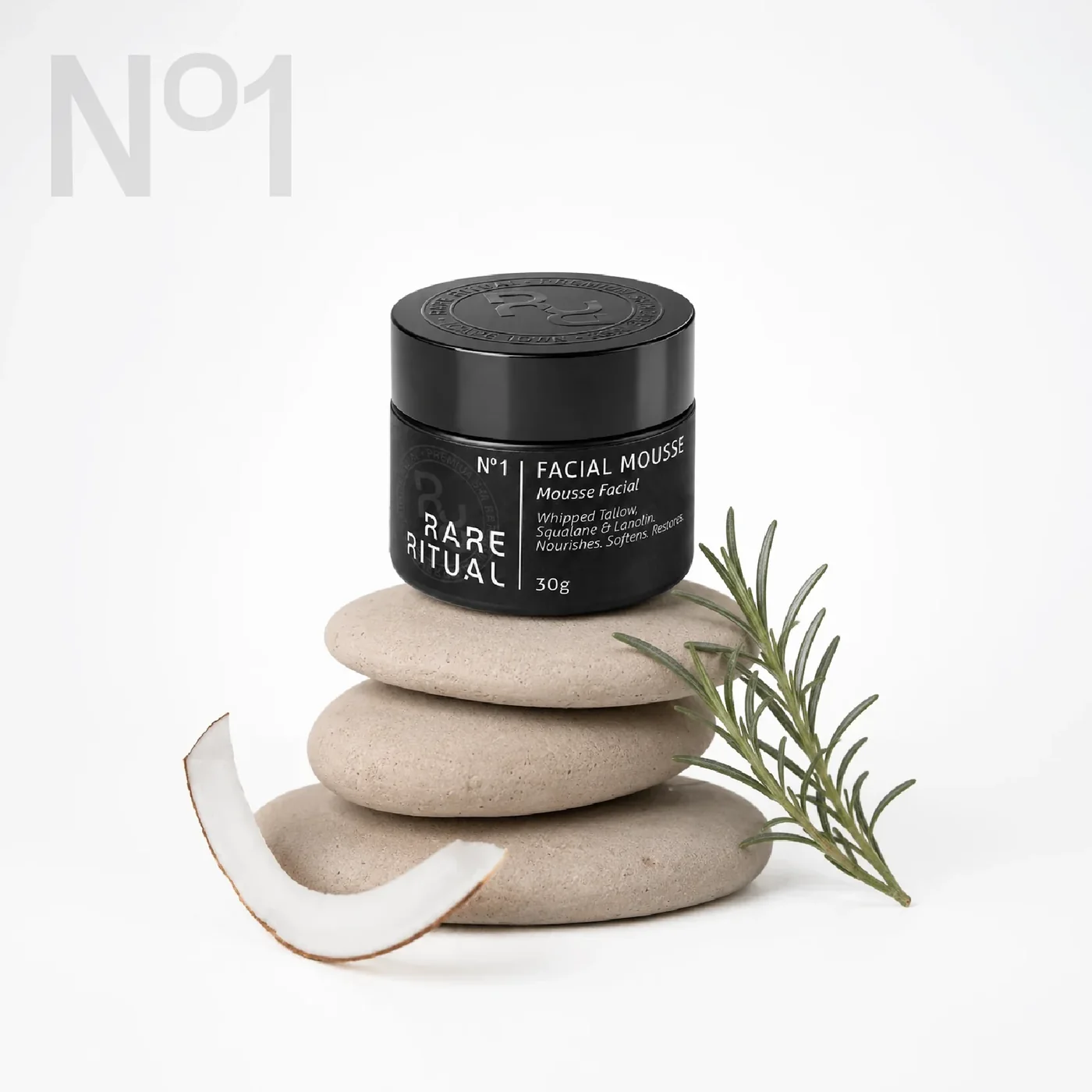
The fatty acids covered here, oleic, palmitic, stearic, and linoleic acid, alongside fat-soluble vitamins naturally present in grass-fed tallow, are the foundation of the No 01 Facial Mousse by Rare Ritual. It is an anhydrous face and neck treatment for all skin types, formulated with grass-fed South African tallow as the primary emollient base. It contains no water, no synthetic preservatives, and no petrochemical ingredients.
For the body, the same tallow base forms the foundation of the No 02 Body Melt by Rare Ritual, blended with Sweet Almond and Castor oils for a texture suited to larger surface areas and drier skin on the body.
If tallow skincare is new to you and you are looking for a clear starting point, the No 01 Facial Mousse is the most direct route into the category. It is formulated around the ingredient rather than around it, and the full ingredient list is published on the product page.