The case for salicylic acid for acne-prone skin starts with a simple observation. Salicylic acid is one of the most well-researched active ingredients in skincare. It has been used to address acne, congestion, and skin texture for decades, and the mechanism behind it is genuinely well-understood. But the way most people encounter it, in toners, pads, and face washes at varying concentrations and pH levels, is often far from optimal. And rarely does it appear alongside the ingredients that address the inflammation and barrier disruption it can cause.
Why salicylic acid for acne-prone skin is uniquely effective: it is lipophilic, so it can cross the sebum-rich environment inside the pore. That is the entire mechanism. Salicylic acid for acne-prone skin dissolves the corneocyte bonds that trap oil and debris, then keeps the pore lining smoother for longer. Paired with botanicals, salicylic acid for acne-prone skin becomes calming as well as clearing.
Understanding how salicylic acid for acne-prone skin actually works, and what needs to accompany it for daily use to be sustainable, changes how you select and evaluate the products you use. Here is what the science says.
How Salicylic Acid for Acne-Prone Skin Works: The BHA Mechanism
Salicylic acid is a beta-hydroxy acid (BHA). Unlike alpha-hydroxy acids, which are water-soluble and work at the skin surface, BHAs are oil-soluble. This is the property that makes salicylic acid specifically relevant to acne and congestion: it can dissolve in the sebum that lines the inside of the pore and penetrate to where the blockage actually forms.
Inside the pore, salicylic acid dissolves the keratin plugs and sebum accumulation that cause blackheads, whiteheads, and congestion. It is a keratolytic, meaning it softens and helps shed the dead skin cells that would otherwise accumulate and block the follicle. Applied consistently at an effective concentration, it reduces the formation of new blockages while helping to clear existing ones.
pH is the variable that determines whether salicylic acid is actually working. For the molecule to remain in its active acid form, which is the form that penetrates the pore lining, the product pH needs to be in the range of approximately 3.5 to 4.5. Above that range, the BHA converts to its salt form, which does not penetrate effectively. Many products contain salicylic acid at a pH too high for it to work as labelled.
Why pH Stability Matters Throughout Shelf Life
A formula at the correct pH on day one is not necessarily at that pH on day 120. Without a buffer system to resist pH drift, the product becomes less effective over time as the pH rises due to contact with air, with the packaging, and with the skin’s own near-neutral surface.
A citrate buffer system, trisodium citrate combined with citric acid, stabilises the pH at the target range throughout the product’s shelf life. It resists both upward and downward drift, meaning the last application in the bottle is as effective as the first. This is formulation detail that separates a well-made BHA product from one that relies on the label alone.
Centella Asiatica: The Healing Active That Makes Daily Use Possible
Salicylic acid clears. But it also mildly disrupts the skin barrier in the process of exfoliating, and without an ingredient that restores barrier function, consistent BHA use leads to dryness, sensitivity, and the rebound congestion that causes many people to abandon BHA products before they see their benefit.
Centella Asiatica extract is one of the most clinically validated healing plants in recorded history, used across Ayurvedic, Traditional Chinese, and Southeast Asian medicine for centuries. Its key compounds, madecassic acid and asiatic acid, have been specifically studied for their ability to calm inflamed skin, support barrier recovery, and accelerate the healing of active blemishes.
In a clarifying formula, Centella does not play a supporting role. It is the active ingredient that makes daily BHA use sustainable. While salicylic acid clears the congestion, Centella calms the inflammation, speeds healing, and restores the barrier that the exfoliation process mildly disrupts. The combination is deliberate, clinically sound, and meaningfully more effective than either ingredient alone.
Blue Tansy: Anti-Inflammatory and the Signal of Genuine Botanical Content
Blue Tansy Essential Oil (Tanacetum Annuum Flower Oil) is produced in Morocco and contains chamazulene, a naturally occurring compound responsible for both the vivid blue colour and the documented anti-inflammatory activity of the oil. Chamazulene is among the most effective plant-derived anti-inflammatory compounds available, and it works in a directly relevant way for acne-prone skin: it targets the inflammation that surrounds every active blemish, reducing the visible redness and discomfort that accompany congestion.
The vivid blue colour of a serum formulated with Blue Tansy at a meaningful concentration is not a dye or an aesthetic choice. It is a direct signal of chamazulene content: a serum that is genuinely blue contains Blue Tansy at a level where the pigment is visible. This makes colour a transparency signal in this context, not a marketing one.
Allantoin and the Dual Role of a Gentle Keratolytic
Allantoin performs two functions in a BHA formula that are often underestimated. As a mild keratolytic, it softens and helps shed corneocytes at the skin surface, complementing the deeper pore-clearing work of salicylic acid. As a wound-healing agent, it stimulates fibroblast proliferation alongside Centella Asiatica, accelerating the process from active blemish to recovered skin.
It also reduces the irritation that BHA exfoliation can cause with consistent use, which makes it a practical component of any formula designed for daily rather than occasional application. Panthenol (Vitamin B5) further supports this function by soothes, hydrating, and supporting barrier function throughout the exfoliation cycle.
Gluconolactone and the Second Exfoliation Layer
Gluconolactone is a naturally-derived polyhydroxy acid (PHA), a gentler exfoliant that works at the skin surface rather than inside the pore. PHAs are larger molecules than BHAs, which means they do not penetrate as deeply, but also that they are significantly less likely to cause irritation. For daily use on sensitive or reactive skin, PHA exfoliation at the surface combined with BHA exfoliation inside the pore provides complementary clearing at two different depths without overloading the skin.
In this formula, gluconolactone also serves as part of the preservation system, in combination with sodium benzoate, which means it contributes active benefit without adding a separate preservative load to the ingredient list.
Where Salicylic Acid for Acne-Prone Skin Comes Together
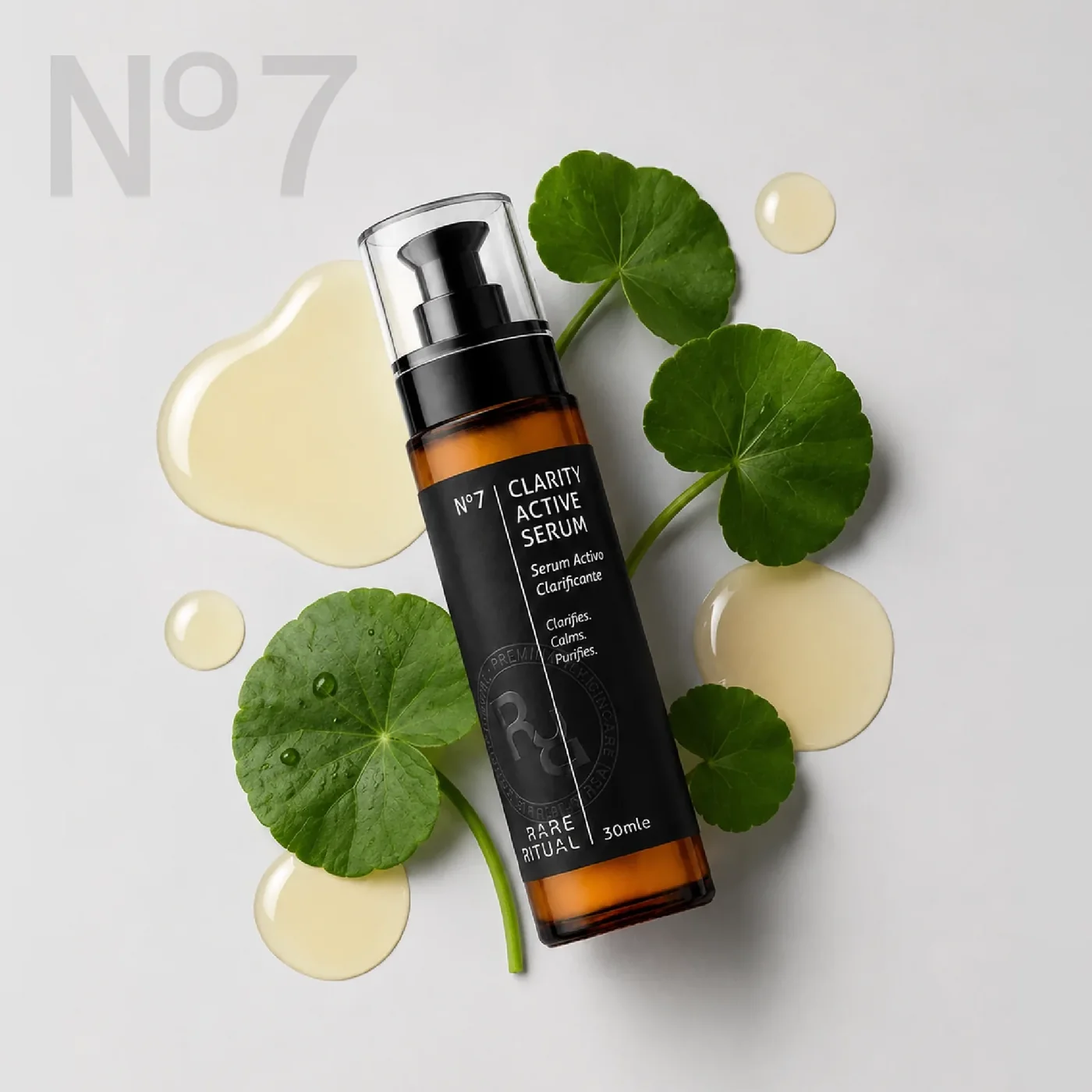
Salicylic acid at pH 3.8 to 4.2, with a citrate buffer for shelf-life stability. Centella Asiatica to restore what the BHA disrupts. Blue Tansy for its chamazulene-driven anti-inflammatory activity. Allantoin and panthenol for barrier support and healing acceleration. Gluconolactone for surface exfoliation and preservation. Salicylic Acid, Centella Asiatica, Blue Tansy, Allantoin, Panthenol, and Gluconolactone all come together in No 07 Clarity Active Serum by Rare Ritual. These are the salicylic acid for acne-prone skin ingredients that make daily BHA use genuinely effective and genuinely sustainable.
They all come together in No 07 Clarity Active Serum by Rare Ritual. A clarifying BHA serum for acne-prone, congested, and sensitive skin that works on the pore, the barrier, and the inflammation all in the same application.