The case for ingredients to fade dark marks starts with a simple observation. Dark marks are among the most common and most persistent skin concerns people deal with, and also among the most frequently misunderstood. Most people who experience post-inflammatory hyperpigmentation, sun spots, or uneven skin tone try product after product without seeing meaningful results, often because the products they are using do not contain the right actives at the right concentrations, or because they are working through only one pathway when effective brightening requires two or more.
What separates the most effective ingredients to fade dark marks from typical brighteners: they act on the enzyme that produces melanin, not on the symptom. Alpha-arbutin and kojic acid are the most studied ingredients to fade dark marks because they intervene at the source. Combined with vitamin C, these ingredients to fade dark marks shift the timeline of post-inflammatory pigment.
The ingredients to fade dark marks that have the strongest research behind them work by targeting the enzyme tyrosinase, which is responsible for the production of melanin. Here is what that means in practice, and why the most effective approaches use multiple mechanisms simultaneously.
Ingredients to Fade Dark Marks: First Understand What Causes Them
Melanin is the pigment that gives skin its colour and that provides a degree of protection from UV radiation. It is produced by melanocytes in the deeper layers of the skin and transferred to surrounding keratinocytes. Hyperpigmentation occurs when this process is triggered disproportionately, producing more melanin in localised areas than in others.
The triggers are several. UV exposure is the most significant and most common cause: UV light directly stimulates melanocyte activity, which is why unprotected sun exposure is both the primary cause of dark marks and the most reliable way to undermine any fading treatment you are using. Post-inflammatory hyperpigmentation (PIH) occurs after any form of skin inflammation, including acne breakouts, injury, or irritation, because inflammation itself signals melanocytes to produce more pigment. Hormonal activity can also trigger melanocyte stimulation, which is behind melasma.
Understanding the trigger does not eliminate the mark, but it does clarify the treatment strategy: to address existing pigmentation, you need to slow or stop melanin production at the source.
Alpha-Arbutin: Tyrosinase Inhibition at the First Lock
Alpha-Arbutin is widely regarded as the most effective over-the-counter brightening active for reducing the appearance of hyperpigmentation, and the mechanism is well-documented. It is a glycosylated form of hydroquinone, which means it delivers hydroquinone’s tyrosinase-inhibiting effect without the irritation, instability, and regulatory restrictions associated with hydroquinone itself.
Tyrosinase is the enzyme responsible for two key steps in melanin synthesis: it converts tyrosine to DOPA, and DOPA to dopaquinone. By inhibiting tyrosinase, Alpha-Arbutin slows and eventually stops melanin production at the source. It is effective on existing marks and works preventatively to stop new pigmentation from developing.
Stability and pH are critical. Alpha-Arbutin performs optimally at an acidic pH, typically in the range of 4.0 to 4.5. Above pH 5, it can convert to hydroquinone prematurely in the bottle rather than on the skin, which reduces both its safety profile and its efficacy. Formulation at the correct pH, held stable by a buffer system throughout shelf life, is what separates an effective Alpha-Arbutin product from one that merely lists it on the label.
Kojic Acid: Disabling the Enzyme at the Second Lock
Kojic Acid, derived from fermentation and used in cosmetic formulation for decades, works through a fundamentally different mechanism from Alpha-Arbutin. Rather than blocking the tyrosinase enzyme directly, it chelates the copper ions that tyrosinase requires to function. Without copper, tyrosinase cannot become active, regardless of how much melanin signalling has been sent. No copper, no active enzyme.
This is why the combination of Alpha-Arbutin and Kojic Acid is demonstrably more effective than either active alone: one blocks the enzyme directly, and the other disables the cofactor the enzyme needs to work. This is two locks on the same door, and the research on dual-pathway brightening consistently shows better and faster results than single-active approaches.
Kojic Acid is effective without risking the irritation associated with higher concentrations, and at pH 4.0 to 4.5 it remains stable in its active form. Like Alpha-Arbutin, it requires correct pH formulation to deliver its promised benefit.
Liquorice Root Extract: Addressing the Cause of New Pigmentation
Most brightening formulas address existing pigmentation. Liquorice Root Extract addresses something equally important: the cause of new pigmentation. Its key compound, glabridin, is both a tyrosinase inhibitor and a potent anti-inflammatory. Its primary role here is upstream of the other actives: it reduces the post-inflammatory response that triggers melanocyte stimulation after a blemish, irritation, or UV event.
For skin prone to post-inflammatory hyperpigmentation, this is not a supporting ingredient. It is essential. Clearing existing marks while new ones are constantly being triggered by unresolved inflammation is a cycle that takes far longer to break than it needs to. Liquorice Root Extract is what helps break that cycle.
Frankincense Hydrosol: An Active Aqueous Base
The most common approach to aqueous serum formulation is to use purified water as the base, which makes the base entirely inert. Frankincense Hydrosol (Boswellia Carterii Flower Water) is a different choice: the aromatic water produced by steam-distilling Frankincense resin, carrying water-soluble polyphenolic and aromatic compounds of the plant in every drop.
Frankincense polyphenols have documented anti-inflammatory and skin-conditioning properties. The mild astringency of the hydrosol refines the skin surface texture with consistent use. An active aqueous base that contributes its own benefit, rather than serving merely as a vehicle for the other actives, is a quality choice in formulation, not just a sensory one.
The Role of Gentle Exfoliation in a Brightening Routine
Brightening without exfoliation is slower than it needs to be. Even when melanin production has been inhibited, the pigment already present in existing surface cells remains visible until those cells shed as part of the skin’s natural turnover cycle. Gentle exfoliation compresses that timeline by supporting the removal of those pigmented surface cells.
Gluconolactone is a polyhydroxy acid (PHA) that provides gentle exfoliation at the skin surface without the irritation risk of AHAs, and without penetrating as deeply as BHAs. It is appropriate for daily use even on sensitive skin, and in a brightening serum it accelerates the physical removal of the pigmented cells that the actives have already stopped producing.
Where the Best Ingredients to Fade Dark Marks Come Together
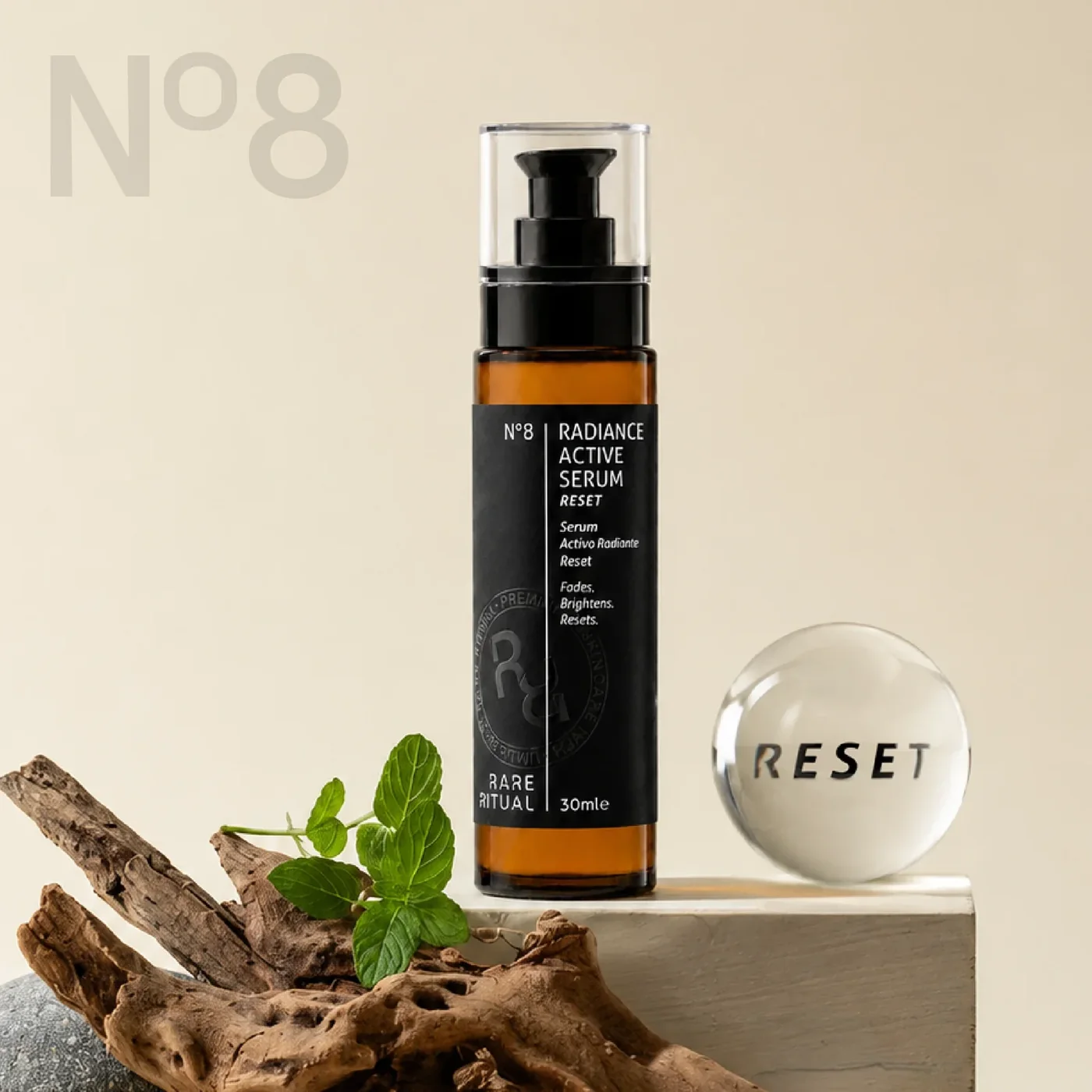
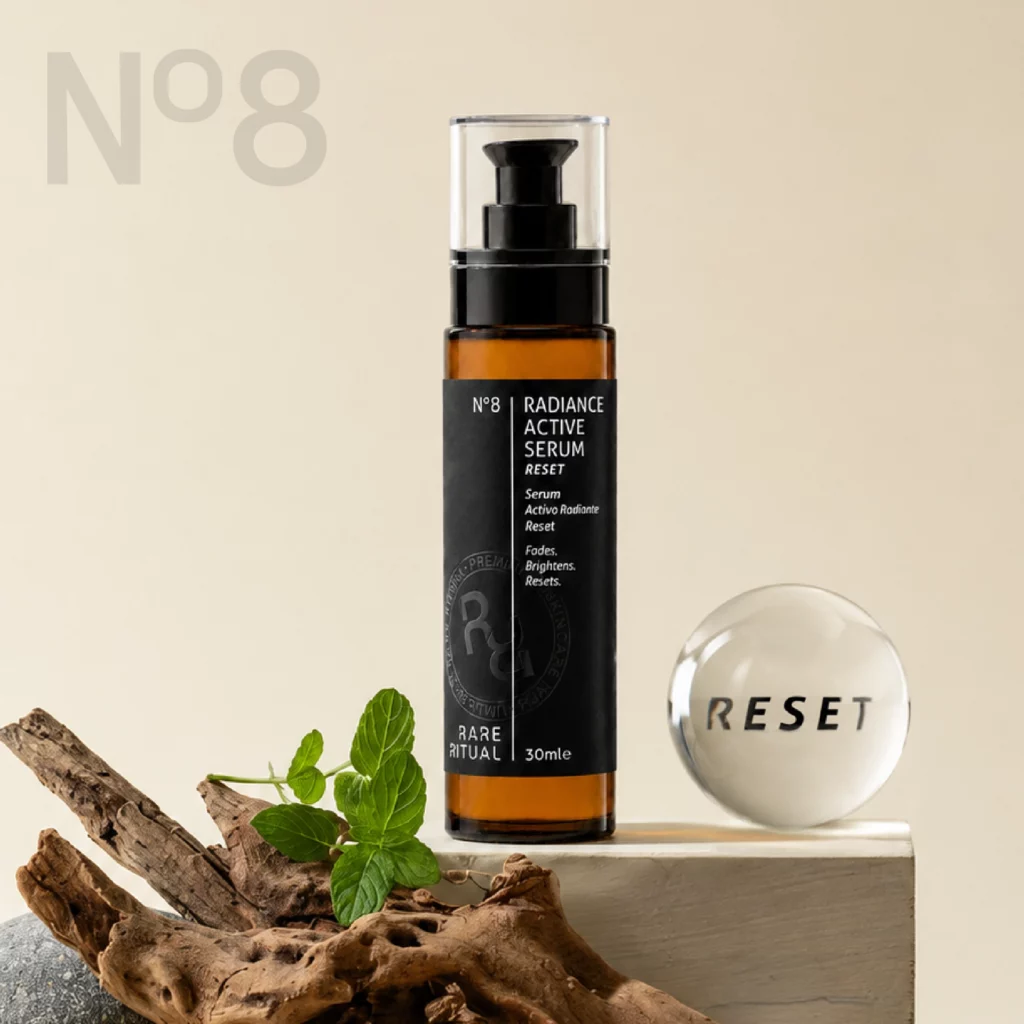
Alpha-Arbutin, Kojic Acid, Liquorice Root Extract, Frankincense Hydrosol, Gluconolactone, Panthenol, Squalane, and Vitamin E all come together in No 08 Radiance Active Serum Reset by Rare Ritual. A brightening serum for dark marks formulated at pH 4.0 to 4.5 for optimal active stability, with a citrate buffer system that holds that pH stable throughout shelf life. If these are the ingredients to fade dark marks you have been looking for, this is where they come together.